Vibe Coding vs Outsourcing
Agencies building proprietary AI has become one of the industry's defining trends. But how many of us are really interrogating what it takes? Pip Bingemann, Co-founder of Springboards, explores the motivations and consequences of this trend.
Nearly every week for the past two years we've seen an agency come out and announce its new proprietary AI platform designed to futureproof them from the tide of change washing into the industry.
And look - the instinct to experiment, to build, to figure out what this technology can do? That's a good - no, great - instinct! We should all be playing with this stuff. But there's a meaningful difference between experimentation and an over six-figure headline investment that claims to have bottled the magic of what an agency does into a piece of software.
The first one I'd encourage wholeheartedly. The second one deserves a harder look.
The rationale driving this is legitimate - there’s a sense AI is going to eat your lunch, so you’d better get there first to have some kind of defensible moat to hide behind. We’ve seen many agencies disappear (DDB, Chep, anyone?) - and the narrative is always the same, they failed to adapt to the new world order.
That’s one of the most eviscerating things someone in an industry which prides itself of being on the vanguard of culture, creativity and innovation can hear. No-one wants to get left behind.
Generative AI technology is genuinely transformative and it’s already changing the equation for much of the industry. So experimenting with your own tools, building things to learn, figuring out where AI can genuinely improve your process - all of that makes complete sense.
The question worth sitting with now is a different one: do you actually want to be in the business of building and selling technology? Because that's a different business entirely.
Agencies are not technology companies and for a long time, that's been their advantage, not their limitation.
Think about what the advertising industry has actually sold for the past hundred-odd years: people and process. People who understand culture, who can make a stranger feel something in thirty seconds, who have the taste and judgement to know when an idea is sharp versus when it just looks sharp.
I’ve come from an agency background, I cut my teeth in media and creative shops and know how they work incredibly well. And yes, I'm an agency person who ended up building an AI platform, so I understand the impulse better than most.
But I also understand the challenges and what it actually takes - all things I didn’t comprehend fully when I started this journey. Creating something that’s not just a minimum viable product you can play about with yourself is costly - both in terms of time and cold, hard cash.
We started Springboards when the generative AI space was only just burgeoning and the benchmark was relatively low. That's not the environment agencies are walking into today.
Every agency has their proprietary framework, their unique methodology, their special sauce - a bit of theatre around a sensible process.
There's nothing wrong with that but the stakes are different now. When a holding company announces it's automating the creative process with a billion-dollar AI platform, it's not just smoke and mirrors - it's actively adding fuel to the argument that the work your people do can be replicated by a machine.
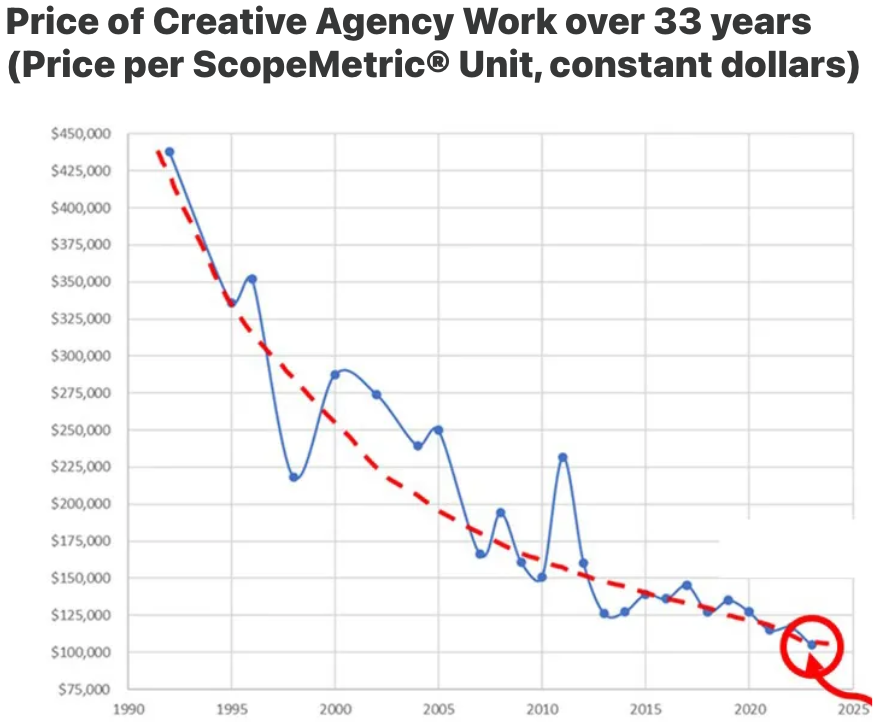
The reality of agencies building their own tools often comes down to margins. Agency margins have been declining for a decade or more. This chart from Michael Farmer’s C-Suite Blues is stark, visual proof of this worrying trend - here, we can see the steep, gradual decline in how agencies price creative work:
All of this is to say that the cash position that might justify a long-term technology moonshot - the kind of burn-now-to-win-later strategy that powers Silicon Valley - simply isn't there.
VCs fund technology companies with the explicit expectation of losing money on the path to dominance. The reality is that for every one or two VC-backed startups that turn into Canva, there are far more that fail.
It's an incredibly risky business model. It works when you have a runway but show me an agency, particularly a publicly listed HoldCo, in that kind of position that has the permission and expectation to fail trying.
There’s also the fact that technology is never just an initial outlay. This is the part that gets underestimated - the moment you build a proprietary AI platform and put it into the world, you're not done - you're only at the beginning of a very long, very bumpy journey.
You're now competing on technology, which means you have to keep advancing it, keep staffing it, keep making it better against competitors who are funded specifically and lavishly to do exactly that and burning millions or billions of dollars each month in the process.
There's also a talent dimension that doesn't get talked about enough. A lot of what AI now handles - competitive audits, first-pass research, early-stage analysis - used to be where junior people learned their craft.
The grunt work, as unglamorous as it sounds, was a training ground. The place where someone figured out what a good brief looks like, what a weak insight feels like and what separates a sharp thought from a predictable one. When you remove that, you compress the development pipeline for the people who eventually make the brilliant work.
Talent development has always been an imperfect science for agencies, and doing less of it, at the same time as redirecting investment away from people entirely, is a compounding problem worth taking seriously.
The question isn't whether to use AI or even whether to build things with it - it absolutely should be part of how you work. It's about being honest about what you're actually in the business of selling.
If you genuinely have the talent, proprietary knowledge and the capital to build something scalable that is going to be better than something that can be repurposed off the shelf, then go for it. The upside potential is enormous.
But if your business was built on human ingenuity - and the evidence of the past hundred years suggests it was - then the more interesting question might be: what would happen if you put that investment into your people instead? Into training programs that actually develop craft and creative judgement or into the processes that make your way of thinking genuinely distinctive?
Because the uncomfortable truth about AI and creativity is it’s generally not good at creating great work. That might sound odd coming from an AI company - but it's exactly why we built Springboards.ai the way we did, with people at the centre of every process and a healthy scepticism toward fully agentic systems that remove human judgement from the equation.
There's certainly something a little upside down about an AI company being the ones flying the flag for human creativity while some of the biggest agency networks in the world seem to be moving in the opposite direction.
The thing that makes an idea land isn't its coherence or its probability, it is the unexpectedness. No-one expected meerkats to sell insurance (Compare the Market) or a passive aggressive owl to encourage second-language learning (Duolingo).
But these were stellar examples of creativity which worked, cut through and grabbed people by the feels and moved markets and built businesses. It is what clients come to agencies for.
That requires human judgement which can only come through lived experience, gut feeling and a lot of counterintuitive thinking to make it work.
Technology has been, is and will increasingly be an important and useful part of your process - a smart, efficiency-generating, possibility-expanding part. But for agencies, the future isn’t about who can produce something faster or more efficiently, it’s about selling the wet matter between your people’s ears which no machine can replicate in a meaningful way.
In case you hadn’t realised already, your clients were buying your people. They still are. Don’t optimise them out.
Want to explore this further? Book a call with the team today.






.svg)