Insights
Vibe Coding vs Outsourcing
Agencies building proprietary AI has become one of the industry's defining trends. But how many are really interrogating what it takes? Springboards Co-founder Pip Bingemann investigates.
Insights
Nearly every week for the past two years we've seen an agency come out and announce its new proprietary AI platform designed to futureproof them from the tide of change washing into the industry.
And look - the instinct to experiment, to build, to figure out what this technology can do? That's a good - no, great - instinct! We should all be playing with this stuff. But there's a meaningful difference between experimentation and an over six-figure headline investment that claims to have bottled the magic of what an agency does into a piece of software.
The first one I'd encourage wholeheartedly. The second one deserves a harder look.
The rationale driving this is legitimate - there’s a sense AI is going to eat your lunch, so you’d better get there first to have some kind of defensible moat to hide behind. We’ve seen many agencies disappear (DDB, Chep, anyone?) - and the narrative is always the same, they failed to adapt to the new world order.
That’s one of the most eviscerating things someone in an industry which prides itself of being on the vanguard of culture, creativity and innovation can hear. No-one wants to get left behind.
Generative AI technology is genuinely transformative and it’s already changing the equation for much of the industry. So experimenting with your own tools, building things to learn, figuring out where AI can genuinely improve your process - all of that makes complete sense.
The question worth sitting with now is a different one: do you actually want to be in the business of building and selling technology? Because that's a different business entirely.
Agencies are not technology companies and for a long time, that's been their advantage, not their limitation.
Think about what the advertising industry has actually sold for the past hundred-odd years: people and process. People who understand culture, who can make a stranger feel something in thirty seconds, who have the taste and judgement to know when an idea is sharp versus when it just looks sharp.
I’ve come from an agency background, I cut my teeth in media and creative shops and know how they work incredibly well. And yes, I'm an agency person who ended up building an AI platform, so I understand the impulse better than most.
But I also understand the challenges and what it actually takes - all things I didn’t comprehend fully when I started this journey. Creating something that’s not just a minimum viable product you can play about with yourself is costly - both in terms of time and cold, hard cash.
We started Springboards when the generative AI space was only just burgeoning and the benchmark was relatively low. That's not the environment agencies are walking into today.
Every agency has their proprietary framework, their unique methodology, their special sauce - a bit of theatre around a sensible process.
There's nothing wrong with that but the stakes are different now. When a holding company announces it's automating the creative process with a billion-dollar AI platform, it's not just smoke and mirrors - it's actively adding fuel to the argument that the work your people do can be replicated by a machine.
The reality of agencies building their own tools often comes down to margins. Agency margins have been declining for a decade or more. This chart from Michael Farmer’s C-Suite Blues is stark, visual proof of this worrying trend - here, we can see the steep, gradual decline in how agencies price creative work:
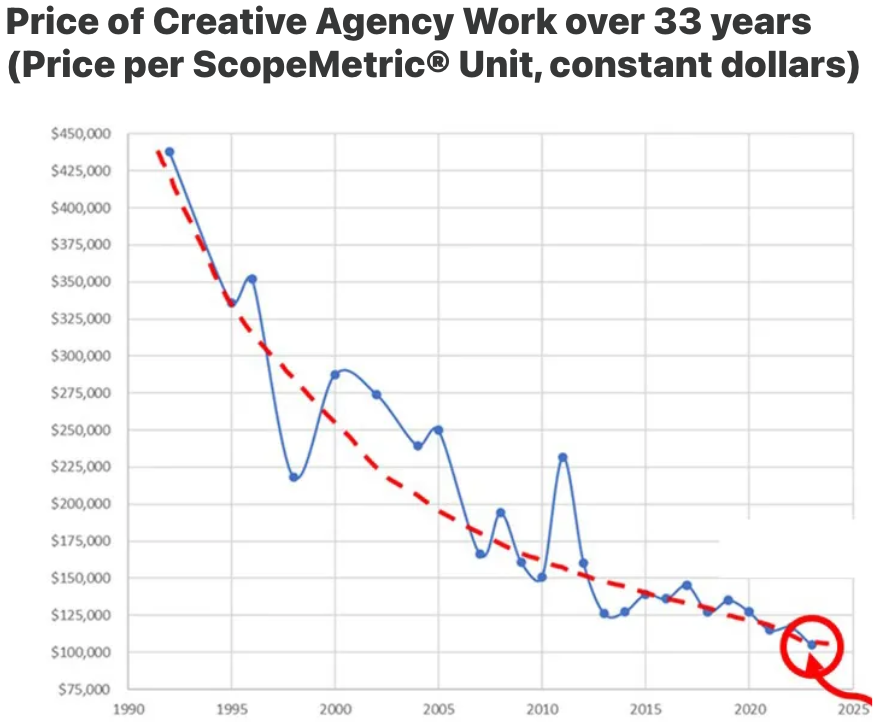
All of this is to say that the cash position that might justify a long-term technology moonshot - the kind of burn-now-to-win-later strategy that powers Silicon Valley - simply isn't there.
VCs fund technology companies with the explicit expectation of losing money on the path to dominance. The reality is that for every one or two VC-backed startups that turn into Canva, there are far more that fail.
It's an incredibly risky business model. It works when you have a runway but show me an agency, particularly a publicly listed HoldCo, in that kind of position that has the permission and expectation to fail trying.
There’s also the fact that technology is never just an initial outlay. This is the part that gets underestimated - the moment you build a proprietary AI platform and put it into the world, you're not done - you're only at the beginning of a very long, very bumpy journey.
You're now competing on technology, which means you have to keep advancing it, keep staffing it, keep making it better against competitors who are funded specifically and lavishly to do exactly that and burning millions or billions of dollars each month in the process.
There's also a talent dimension that doesn't get talked about enough. A lot of what AI now handles - competitive audits, first-pass research, early-stage analysis - used to be where junior people learned their craft.
The grunt work, as unglamorous as it sounds, was a training ground. The place where someone figured out what a good brief looks like, what a weak insight feels like and what separates a sharp thought from a predictable one. When you remove that, you compress the development pipeline for the people who eventually make the brilliant work.
Talent development has always been an imperfect science for agencies, and doing less of it, at the same time as redirecting investment away from people entirely, is a compounding problem worth taking seriously.
The question isn't whether to use AI or even whether to build things with it - it absolutely should be part of how you work. It's about being honest about what you're actually in the business of selling.
If you genuinely have the talent, proprietary knowledge and the capital to build something scalable that is going to be better than something that can be repurposed off the shelf, then go for it. The upside potential is enormous.
But if your business was built on human ingenuity - and the evidence of the past hundred years suggests it was - then the more interesting question might be: what would happen if you put that investment into your people instead? Into training programs that actually develop craft and creative judgement or into the processes that make your way of thinking genuinely distinctive?
Because the uncomfortable truth about AI and creativity is it’s generally not good at creating great work. That might sound odd coming from an AI company - but it's exactly why we built Springboards.ai the way we did, with people at the centre of every process and a healthy scepticism toward fully agentic systems that remove human judgement from the equation.
There's certainly something a little upside down about an AI company being the ones flying the flag for human creativity while some of the biggest agency networks in the world seem to be moving in the opposite direction.
The thing that makes an idea land isn't its coherence or its probability, it is the unexpectedness. No-one expected meerkats to sell insurance (Compare the Market) or a passive aggressive owl to encourage second-language learning (Duolingo).
But these were stellar examples of creativity which worked, cut through and grabbed people by the feels and moved markets and built businesses. It is what clients come to agencies for.
That requires human judgement which can only come through lived experience, gut feeling and a lot of counterintuitive thinking to make it work.
Technology has been, is and will increasingly be an important and useful part of your process - a smart, efficiency-generating, possibility-expanding part. But for agencies, the future isn’t about who can produce something faster or more efficiently, it’s about selling the wet matter between your people’s ears which no machine can replicate in a meaningful way.
In case you hadn’t realised already, your clients were buying your people. They still are. Don’t optimise them out.
Want to explore this further? Book a call with the team today.
Insights
Embrace brand, performance and the future of creative work with James Hurman
Start marketing to tomorrow's customers today. Discover James Hurman new model of marketing with Spark Sessions. Why brand and performance aren't in conflict, and what it means for creative work in an AI-first world.
Insights
James is one of the most influential thinkers in Marketing today and for those who weren’t able to make the session - he was every bit the “James Hurman” you’ve heard about, sharing his gift for being able to simplify the complex.
“Future Demand” is not only the title of his latest book but also the lens through which he argues we need to fundamentally rethink how marketing works. The name is straightforward, but what sits behind it is thirty years of marketing science, distilled into something you can act on immediately.
Hurman systematically - and politely we might add, exposed one of the most stubborn arguments in our industry for what it actually is. An endless and sadly unnecessary tug of war. The rational and the emotional or as the industry tends to express them - performance and brand. We have spent decades treating these as opposing forces, as if choosing one means sacrificing the other.
James's argument is that this tension was never real. It was merely a symptom of asking one piece of communication to do two fundamentally incompatible jobs. The moment you separate those jobs i.e. convert current demand over here, create future demand over there, the tension collapses. Rational and emotional are not in conflict. They are just answers to different questions. The brief that needs to close a sale today should be rational. The brief that needs to plant something in the mind of a buyer who won't show up for six months should be emotional. Both are right. Neither is wrong. They were just never meant to be the same brief.
If you get nothing else from this Spark Sessions masterclass, the evidence and framing Hurman uses to make this argument is worthwhile. Most marketers know this intuitively, but the ability to level this argument in a compelling and simple way is truly powerful.


If you take this framing a step further though into implications for your craft, the session can also empower your performance work to be just that - simple and direct, it can also give your brand work greater permission to be genuinely creative. The second layer to this session - which he weaves throughout his evidence, is the clear acknowledgement in how the laws of demand creation vs demand capture differ.
We all know this as Marketers, but no matter how drastic a shift in the way we interface with technology, the way we make decisions hasn’t changed that much at an emotional level. That change takes a long time. It means that although new category entry points and media touchpoints might exist in an AI-enabled world, brands are built with the same basic ingredients. How and when you use these ingredients has changed somewhat, but the human part - the creative part - that’s still the point of difference.
That very human Creativity is something we believe is at the core of all marketing considered to be valuable today. That’s the part we get really riled up about! Given how steeped our industry and space is in technology and what’s new, it’s important we’re protective of what actually makes marketing the most valuable. Data-rich addressable channels and finely tuned conversion engines are all happy by products of a really bloody good creative idea. So - if you take anything else away from Hurman’s work, perhaps some encouragement in that the biggest driver of brand value remains purely biological.
If you extrapolate Hurman’s lens to how we see people deploying AI in Marketing…the Strategies relevant in demand capture just aren’t relevant in demand creation. So, why would you use the same tool to analyse your search data to develop a creative concept for your brand TVC? It’s a crude analogy but specialism matters here, which is a big part of why Springboards exists.
Most AI models are built to converge, to find you the most polished, probable and expected answer. That’s a feature if you’re trying to find out what ad performed best in your Search Campaign, if you’re a creative or a strategist trying to build an idea for future demand - that’s a bug. We built a platform designed to help you expand your range of thinking, to help teams explore more possibilities without replacing human judgement or craft. The unexpected needs to be intentionally pursued in an AI-enabled world, and we’re passionate about creating and protecting those environments.
Want access to masterclasses like James Hurman?
Unlock Springboards + monthly Spark Sessions for as little as $1 a day.
New here? Start a free trial today.
Already a customer? Watch it on-demand.
Up next: Mark Pollard
Join us June 24 @ 9:00 EDT with Mark Pollard for his "How the world thinks" masterclass.
Having spent years travelling, talking to people, collecting ideas from places most strategists never look - this is a tour of that thinking. Sign up today.

Insights
Choosing the Whetstone path. Sharpening your creativity with Zoe Scaman
Stop using AI to smooth your edges. Discover Zoe Scaman’s "Whetstone" approach with Spark Sessions. A guide to using AI to map your tacit knowledge and sharpen your unique creative perspective.
Insights
For those who have followed Zoe Scaman on LinkedIn, she stands out not only for her intelligence, but her refreshing honesty. She exudes someone who has spent a career refining who she is and how she thinks. In this session, she showed us her working.
The topic of her talk was “The Whetstone” - the name perfectly encapsulates a competitive advantage that starts with mapping out our own practice. Not easy, but we left feeling it’s a rewarding journey to undertake. As she says, a sharper blade cuts further.
And that is what choosing the Whetstone path is really about. It’s a decision to use AI not to do the work for you, but to sharpen your mind. While many people are still using AI for efficiency, Zoe offered the perspective of levelling up. She uses AI to map her unique thinking processes and continues to sharpen as she sharpens. The journey of self-discovery that it takes to get there involves extracting tacit knowledge you’ve built up over a lifetime, but often can’t articulate.
Over the course of our careers, many of us have learned how to become an arbiter of our own taste. How to form our own distinct views. How to define and sharpen our personal brand. Our creative industry isn’t one you can simply learn out of a textbook. It has always been about tapping into the unique strengths and experiences that give us our own way of seeing the world and the challenges in front of us.
Zoe’s map of tacit knowledge will look different to each of ours. It was fascinating to hear how she holds a mirror up to the different experiences that make her think the way she does today. It’s not something you or I can simply copy and paste. That is the beauty of the human, unpredictable paths we have all taken.
Zoe’s advice is simple. Go on a walk. Get introspective. Map out the things that make your thinking different. Then use AI to help you extract the things you can’t put into words. Ask it to make you react and give your opinion. Do the hard work to put those indescribable strengths into codified thinking that you can continue to shape. It is not a one and done exercise. Our daily experiences will continue to change our viewpoint.
This is exactly why Springboards exists. In a world where unique perspectives are being whittled away to a sea of sameness, this is the work worth doing. We built a tool that takes on the tension between creativity and the pattern prediction of AI.
When you bring your own map of tacit knowledge into a session, you start to use AI in ways that do not feel like a path to average. It was a breath of fresh air to think that we can continue to defend the quirks of our humanity that lead to unexpected, creative thinking.
Most surface-level AI output isn’t wrong. It’s just dull. It will get you through the day, but it won’t cut through. Zoe’s point is that sharpness is still a choice. You either use these tools to smooth your edges, or you use them to find them and refine them. In choosing the Whetstone path, you’re protecting the most important creative differentiator you have, yourself.
Want access to masterclasses like Zoe Scaman’s?
Unlock Springboards + monthly Spark Sessions for as little as $1 a day.
New here? Start a free trial today.
Already a customer? Watch Zoe Scaman’s full Spark Session on-demand.
Up next: James Hurman
Join us May 28 @ 8:00 NZST with James Hurman for his "Future Demand" masterclass uncovering why marketing to tomorrow’s customers will break your brand out of the performance trap.
James will reveal why so many brands have optimised themselves onto a growth plateau, and share the evidence-based way out. Drawing on decades of global research, he’ll show what brands can do to create profitable growth that scales.
This session proposes a new mental model for marketing, built on how markets really work, how humans really make decisions, and how advertising really creates sales. Sign up today.
In the news
IWD: Five business and life lessons from three years as a female founder
Amy Tucker shares five lessons from three years building Springboards, covering leadership, resilience, and what nobody tells you about starting a company.
In the news
We never planned to launch a tech startup. But when my partner Pip and I were laid off within three weeks of each other, we needed to back ourselves. It hasn’t been easy, but I’ve learned more in the last three years than in the first decade of my career.
Up until that point, my career had been pretty well mapped out. I started in Sydney media agencies learning the industry and then landed a job at a creative agency in San Francisco, which almost inevitably led to jobs in the tech sector at Twitter and then Shopify. Pip’s journey was very similar, but substitute tech for creative agency land and a Web3 company (remember those?).
COVID hit and we decided to move back to Australia - Noosa in fact - and we were able to work our roles remotely from there for a while. Then, in mid-2022, the music stopped very suddenly for us both and we had some choices to make.
We began consulting remotely from Noosa and started using in earnest some of the new AI tools which were emerging on the market at the time. It all felt like a kind of magic, but too often we were finding that the end result was generic and disappointing and we knew there had to be more they could do for us.
So we taught ourselves to code so we could engineer them to be fit for the work we were doing and give us the output we were looking for. We presented the first MVP version at a conference in Sydney just to demonstrate the potential - what we didn’t expect was people’s immediate reaction in asking how they could buy it, invest in the company or partner with us there and then.
We left that room with 50 people willing to pay to beta test a product that didn't yet exist but the knowledge we were really onto something. We brought in Kieran, our technical co-founder, and gave him four weeks to build it properly. No pressure!
That's how Springboards started. Not with a vision statement or a pitch deck, but with redundancy, curiosity and a deadline we'd created for ourselves before we were ready for one.
I tell that story because everything I've learned about collaboration, ambition and what it actually takes to build something came from the particular kind feeling that we were really onto something and the energy that is generated when you’re feeling inspired.
Taking off the mask
Corporate America is fairly performative. It can be fast paced and invigorating, but there’s always a lot of internal politics to navigate and egos to stroke. I learned quite quickly I needed a work version of myself to help navigate that environment.
But when your co-founder is also your life partner, there's no work version of you to present. No polished front, no selective disclosure. Pip has seen every version of my thinking including the terrible ideas, the half-formed ones and the ones I was confident about at 11pm that I quietly abandoned by morning.
That's confronting at first because there’s nothing to hide behind - you’re totally exposed. It's the things that make you more creative. You can diverge and converge in a really natural and safe way that feels intuitive to the vision.
We can challenge each other without ego in the way. We can say "that's not working" without it requiring a meeting. And when the great ideas do spring forth it also means there is no friction or ego to manage, we trust each other wholeheartedly to just run hard at it.
We can also, genuinely, call it when one of us is being the problem rather than solving it.
External perspective
That last one is harder than it sounds, both professionally and personally. Knowing when to step back, when your idea isn't the right one, when you're blocking rather than building and being able to do that without taking it personally is probably the most important skill we've developed.
What makes it work is having a third co-founder who has nothing to do with our relationship. Kieran is the person we can go to when Pip and I have genuinely opposing views. He's measured, external to our dynamic, and willing to pressure-test the thinking without the noise of two people who also happen to share a mortgage and daycare pickups.
Every partnership needs a version of that: someone who sits outside the gravity of the relationship and can give trusted guidance or bring the temperature down.
Balance is about being realistic
The other thing I've stopped pretending about is boundaries.
Our worlds are completely intertwined - an early-stage startup, two young kids, constant decision-making - some weeks "switching off" is a fiction. What we've found works better than strict separation is integration: being genuinely aligned on what matters, having honest conversations about what needs doing and who's best placed to do it and recognising when the conversation needs to stop because it's not useful anymore.
Our potential is far greater than we typically give ourselves credit for and you can’t have everything at once. Both of those things are true at the same time and sitting with that tension honestly is part of what building something real requires.
We invested everything into this. It wasn’t necessarily a conscious decision, there was no big upfront conversation about what happens if this fails or if we’re willing to back each other - that was something we both knew coming into this, and still do.
It’s important to have that psychological safety to know this one, very important, part of your lives won’t bring down the other more important part - that creates the freedom to make bold decisions day to day.
Taking your place at the table and building better
Building in AI has meant spending time in a lot of rooms where I'm the only woman at the table. What's shifted for me isn't volume or presence in any performed sense, it's conviction. When you believe in what you're building and you know it matters, you stop needing permission to be in the conversation.
We've also been deliberate about the company we're creating: around 70% of our leadership team are women and most senior roles are held by women. In a space where AI tools are being built to influence how people think and create, who's in the room when those decisions get made is not a secondary consideration - it's the work.
International Women's Day tends to celebrate the moment of stepping forward. What gets less attention is the architecture underneath - the trust, the honesty, the people who will still be there if it goes sideways.
That trust removes more friction than any strategy document I've ever written - although to be clear, we do now have a very robust plan and roadmap as well as a fantastic team driving things forward with us.
The village matters, the honest conversations matter and the willingness to be genuinely okay with all versions of the outcome is what makes the bravery possible in the first place.
What I have very much realised is startups are like children - you can read all the books and guides on what to do and what to expect, but the only way to actually make them thrive is to be guided by what’s in front of you, trust your gut instinct and your own expertise in what you’re building.
Ultimately, you’ve got to run your own race the best way you see fit and lean into the support around you.
Insights
Fast Five with Chris Turney
Fast Five is our rapid-fire interview series, 5 questions, 5 minutes. Next up, Chris Turney shares sharp insights on creativity, advertising, AI and more.
Insights
How do you define creativity?
It sounds overly simple, but expression at its purest. The way only you see the world and the weird way in which you decide to express that. That can be in music or art or math or a silly little pitch deck or in the song you make up to sing to your dog.
Is AI a friend or a foe?
Neither - that gives it way too much power. Practically speaking, at a systems level, AI is going to raise the floor, but it's also going to lower the ceiling. I saw Chris Anderson from Wired do a talk in the early days of Maker culture mania. He likened the era to early internetting and Geocities. There's going to be a lot of shit until it gets really good. And then it's going to get intrusively spectacular. And then it's going to be frictionlessly and technically excellent that we don't notice it. When AI is no longer THE thing, I look forward to what things we can actually do with AI.
Name a piece of work that AI could never have come up with?
Anything Hunter S. Thompson. That level of chaos and "wrongness" is impossible to be predictable.
What’s the weirdest place you’ve ever found a great idea?
I don't know the weirdest place I've ever gotten an idea, but I'm keeping my weirdest billion-dollar idea a secret for now!
Favourite AI hack or use case? What do you think it is good for?
Mine's incredibly practical right now. I think it's valuable for pressure testing brand frameworks, especially for quite specialty audiences in complex fields. It's never the answer, but it's enough of a starting point, I can fumble my way through it.
Insights
Super Bowl 2026: Still glorious. Slightly less sparkly.
In this take on Super Bowl 2026, Creative minds Geoffrey Sexton and Carolyn Murphy ask the real question: where was the risk behind all that shine?
Insights
Super Bowl. The greatest day in the calendar for Advertising. It's an embarrassment of riches, promotional excess and big bets. It’s glorious.
My second favourite thing after the great Football Advertising Party is reading and writing all about it. The hot takes. The bold claims. The annual flurry of loosely qualified assertions about how the landscape has forever changed. We in advertising never waste a good opportunity to declare a turning point. Naturally, we gorged ourselves. And although I might just be getting a bit older, both Caro and I couldn’t help but notice this one felt a little less sparkly.
Back on home soil, Caro was watching with equal parts ad-nerd enthusiasm and Patriots-induced heartbreak. Her read was immediate: the game felt a bit flat. And so did some of the ads. The sparkle was missing.
Not all of it, of course. There were proper bright spots.
Liquid IV leaning into a hydration truth most of us have quietly validated with a sideways glance. I suspect very few AI tools would confidently surface that particular insight if prompted. Kellogg’s William Shat Raisin Bran fibre reveal. Annoying, until it clicked. Then genuinely smart. Novartis weaving tight ends into preventative screening with surprising elegance.
Bathroom humour. Fibre jokes. Locker room puns. Juvenile? Slightly. Human? Completely. And maybe that is the point. Because the human bits cut through.
But let's talk about the very well-paid elephant in the room. Celebrities.
This reached a fever pitch last year and although their inclusion is down from 68% of all ads to 62%, it’s clear brands are still hedging risk and distinctive efforts with these folk. There’s nuance here. We can probably expect the number to keep falling. Others have addressed the issue more comprehensively. But the rule I was taught (and still try to stick to) is simple: fame is a byproduct, not a strategy.
Caro put it more bluntly: “if the idea only works because the celebrity is famous, it’s not an idea. It’s insurance.”
Insurance isn’t inherently bad. Insurance can feel safe. But safe rarely makes history.
And speaking of safe… Let’s talk about the other buzzword of the night, besides “field goal.” AI.
Interestingly, there may not have been a huge amount of AI used in the ads themselves (beyond Svedka, who at least admitted it). But there were certainly a lot of ads for AI. If Caro’s tracking is correct, we saw:
Anthropic: their first ever Super Bowl spot, clearly differentiating itself in the LLM race.
OpenAI: a 60 national Codex spot, plus regional ads showcasing small businesses leveraging ChatGPT.
Google Gemini.
Microsoft Copilot.
Amazon (Ring and Alexa. Framed as helpful, but among Caro’s watch party crowd, more than a few felt “creepy”).
Genspark, which sparked a different kind of room reaction: “Is this taking my job?”
Salesforce promoting Slack AI.
ai.com, which left many wondering what, exactly, it does.
From our vantage point at a scrappy AI company from Down Under, it was fascinating to watch the category openly confront itself on the biggest stage in culture. It is a competition, after all. And although many in our space are still learning how to “Super Bowl” (present company included), the open confrontation across tech and beyond was refreshing.
At the risk of alienating the EBI crowd, acknowledging your competition doesn’t simply donate attention to the category leader. Positioning still matters.
While I admired the spirit of Anthropic’s work, it reminded us of something Reed Hastings once said about Netflix: “No advertising coming to Netflix. Period.” Less than two years later, that position shifted. As the major players in AI fight to become the homepage of the internet, there are probably lessons to be learned from the streaming wars.
So yes. A few observations. A few trends. A few stats. But so what? Risk is so what.
Risk underpins every great Super Bowl ad in history. Every great campaign. The work we still talk about didn’t come from playing it safe. It came from someone taking a calculated leap. This year, outside of a few friendly swipes, felt more than a bit cautious. One of the more frustrating paradigms in Advertising is the idea of maths versus magic (as though we have to choose between data and creativity). Realistically, you need both. It’s a false dichotomy.
Magic i.e. creativity is, fortunately, much more difficult to train a language model on. It’s an innately human pursuit that the machines we’re currently enamoured by aren’t very good at on their own. They recognise patterns and desperately avoid risk. There is an answer to this, or at the very least, a wealth of inspiration.
If you want to see something risky, have a look at our Super Bowl spot. Apologies, experiment (for many reasons, most of which are legal). And if you have an appetite for risky work, please reach out - so do we.
We’ve built something that inspires you to find the risks worth taking.
The kind we both kept wishing we’d seen more of this year.
Insights
Fast Five with Zoe Scaman
Fast Five is our rapid-fire interview series, 5 questions, 5 minutes. Next up, Zoe Scaman shares sharp insights on creativity, advertising, AI and more.
Insights
How do you define creativity?
The act of noticing what others have learned not to see. It’s pattern recognition mixed with emotional intelligence and just enough mischief to rearrange the world. It’s not the spark, so much as it's the reframing. The ability to pick something up - an object, a memory, a myth, a moment in culture - turn it in your hand and say: What if this means something else?
Is AI a friend or a foe?
AI is a mirror - and we don’t always like what we see. If you treat AI as a shortcut to “content,” you’ll get the flavourless soup you deserve. Rooms full of brand decks that sound like they were all written by the same middle manager in Slough. The cultural beige-ification of everything. But if you treat AI as a thinking partner - a provocation engine - you get something very different: velocity. Expansion. A chance to stretch beyond the first, obvious idea and get to the uncomfortable, interesting ones faster. AI doesn’t threaten originality. AI threatens laziness. And perhaps that’s overdue.
Name a piece of work that AI could never have come up with?
Ursula K. Le Guin’s The Carrier Bag Theory of Fiction. A model could replicate the sentences. It could summarise the thesis. It could imitate the rhythm, even. But it could never arrive at the idea. Because that essay wasn’t produced through analysis, it was produced through perception. Through noticing. Le Guin takes the oldest story humans tell - the hero, the weapon, the conquest - and quietly dismantles it with a single reframing move: The first human tool was not a spear. It was a carrier bag. A container. A holder. A vessel for sustaining life rather than taking it. From that one shift, the entire architecture of storytelling tilts. Narrative becomes collective, not competitive. Power becomes relational, not dominant. Survival becomes shared, not won. No machine does that. No dataset teaches you to subvert the underlying myth of civilisation itself.
Ursula K. Le Guin - The Carrier Bag Theory of Fiction
What’s the weirdest place you’ve ever found a great idea?
Cleaning out cupboards is a favourite pastime. When the brain is bored and the hands are busy, the doors between the conscious and the sub-basement swing open. The good ideas live in the plumbing. They surface when the performative, clever, “I am ideating now” brain shuts up.
Favourite AI hack or use case? What do you think it is good for?
I use AI like a conceptual centrifuge. I throw in: a paragraph, a suspicion, the outline of a thought.I ask it to reshape it - longer, shorter, slower, mythic, corporate, angrier, whispering, bored. Not to pick one, but to see the shape of what it could be. Draft zero, rather than draft one. It keeps me from falling in love too early with my own cleverness.
Insights
Fast Five with Matt Herrmann
Fast Five is our rapid-fire interview series, 5 questions, 5 minutes. Next up, Matt Hermann shares sharp insights on creativity, advertising, AI and more.
Insights
Who are you?
Matt Herrmann
How do you define creativity?
Creativity is the alchemic act of seeing what has always been there and articulating it in a way that feels both new and inevitable.
Is AI a friend or a foe?
Neither and both? It's a phenomenal thought partner and conceptual tennis wall - a very helpful and tireless intern with perfect memory and no gut. It will become a foe if we forget about the importance of emotional experience when trying to connect a human with a brand.
Name a piece of work that AI could never have come up with?
One of my favourite lines of copy ever written is for Malort, a famously foul tasting booze popular in Chicago. The line is "Malort: Tonight's the night you fight your Dad." It's the kind of absurd yet truthful and insanely specific idea that requires instinct, cultural understanding that a machine built to be very good at predicting the next word would never come up with.
It's my favourite T-shirt - here's a link to where you can't buy it anymore because it's that good.
Postmark - Malort, Tonight's the night you fight your Dad t-shirt.
What’s the weirdest place you’ve ever found a great idea?
I don't know if this is weird, but I used Emile Durkheim's theory of the separation of the sacred from the profane to suggest that trash bags can become elevated to a type of religion. Still one of my favourite briefs.
Favourite AI hack or use case? What do you think it is good for?
I love to have an agent debate itself. It's great for following a line of logic down a rabbit hole or up into the stratosphere. I love that it has no shame or self-consciousness about taking the most ridiculous ideas far beyond their logical conclusion.
Events
Insights from ladies who strategise AI summer webinar
Amy Tucker explains why most LLMs are not bad, just boring. LLMs optimise for the most likely answer, making them probability machines, not creative machines.
Events
Unleashing Human Creativity in an AI-Driven World
AI is moving at warp speed. ChatGPT hit 100 million users faster than TikTok, and now every second LinkedIn post is someone breathlessly declaring “the future of work.” But speed doesn’t equal creativity. In fact, if we’re not careful, AI could speed us straight into a world of beige.
Demystifying the magic trick
When we kicked off our Springboards + Ladies Who Strategize (LWS) AI Summer webinar series, our co-founder Amy Tucker shared her take with the group: most AI outputs aren’t bad, they’re just boring. LLMs like ChatGPT are built to give the “most likely” answer. LLMs don’t “understand” your words; they break everything down into tokens and then spit back the most likely sequence. In other words, they’re probability machines, not possibility machines.
That’s why they’re fast and impressive, but also trained to follow a pattern. Amy demoed it live: ask an LLM any number 1 to 10 and you’ll get the same “random” outputs. Another example: Two different marathon runners received identical training plans from an LLM. Even creative asks like ideas for “band names” collapse into predictable, low-entropy answers.
Machines don’t dream. They echo.
Breaking the gray with Springboards
Springboards was built to be the antithesis of LLMs. We don’t hand you the most probable answer. We hand you sparks, weird prompts, thought-starters, and curveballs, designed to push your brain somewhere it wouldn’t go alone.
Our platform has modes literally called LSD and Asylum for a reason. They’re not about being safe or efficient; they’re about messing with the machine until something interesting, unexpected, and fun falls out.
Because we believe the real power of AI isn’t about removing humans from the process. It’s about supercharging them.
What AI is good for (and not)
Amy also talked about where AI does shine:
- Getting you up to speed fast on new topics
- Spotting patterns in mountains of data
- Helping you flip perspectives or reframe a problem
- Generating starter ideas you can riff off
But let’s not kid ourselves. AI isn’t good at originality. It isn’t good at taste. And it definitely isn’t good at giving you the kind of hard feedback that makes an idea go from okay to killer.
That’s still the human superpower.
Humans + AI > boring
So where does that leave us? Pretty optimistic, actually. New tools always bring new possibilities. Just like the camera didn’t kill painting, AI won’t kill creativity. It just changes the canvas.
The challenge — and the fun — is learning how to break these tools in ways that make space for more imagination, not less. That’s exactly what Springboards is here for: keeping creativity human, playful, and just the right amount of weird.

Events
Springboards to Pitch and Present at SXSW Sydney 2025
Springboards has been named a finalist in the SXSW Sydney Pitch 2025 and will present new research on creativity in AI. Here’s what we’re bringing to the stage.
Events
It’s official: Springboards is heading to SXSW Sydney. We’re pitching, we’re presenting, and we’re bringing our take on AI + creativity.
Out of hundreds of startups across APAC, we’ve been chosen as one of just 23 finalists for the SXSW Sydney Pitch 2025, competing in the Enterprise, Big Data & AI category.
We’re proud to be repping creative humans in a sea of tech startups.
Check out the rest of the finalists here.
And we’ll be on stage to present findings from the Creativity Benchmark
Our co-founders, Pip Bingemann (CEO) and Kieran Browne (CTO) will also take the stage to present: AI on Acid: Breaking the Machines to Break the Mold.
This session will unveil results from Creativity Benchmark, the world’s first industry research testing AI’s creative potential, not just its logic.
Launched with partners the APG, IAA, 4A’s, One Club, D&AD, ACA and IPA, the benchmark looks at: Which models are the best at inspiring creativity? And what does that mean for the work we make?
We’ll share the findings and what this means for the industry.
Read more about the other sessions in the Tech and Innovation track at SXSW Sydney here.
See you at SXSW Sydney.

Insights
Fast Five with Eleanor Rogers
Fast Five is our rapid-fire interview series, 5 questions, 5 minutes. Next up, Eleanor Rogers shares sharp insights on creativity, advertising, AI and more.
Insights
Name
Eleanor Rogers, former Sales Director at Snap
How do you define creativity?
The true sign of intelligence is not knowledge, but imagination.” —Albert Einstein
Is AI a friend or a foe?
It depends who is in the driving seat and who is the back seat. If it helps you detect early disease and shares a personalised treatment plan to help heal you then it’s a saviour. If you just lost your job as AI has taken over then it’s the devil.
Name a piece of work that AI could never have come up with?
John Lewis Christmas Advert 2011 - The Long Wait
One of my all time English favourites that soothes the soul for all parents who worry about their kids and the damage of consumerism. Honestly though there isn’t a creative in history that AI couldn’t have a helping hand in to make the process shorter & smoother.
What’s the weirdest place you’ve ever found a great idea?
Pain. Pain is the place where you meet a new version of yourself and is a catalyst for thinking and seeing the world in a different way.
Favourite AI hack or use case? What do you think it is good for?
Uploading medical reports on a damaged knee to find out absolutely everything I can do to get back on the black runs one day.

Insights
Fast Five with Gabrielle Tenaglia
Fast Five is our rapid-fire interview series, 5 questions, 5 minutes. Next up, Gabrielle Tenaglia shares sharp insights on creativity, advertising, AI and more.
Insights
Who are you?
Gabrielle Tenaglia, Head of Marketing, Lettuce
How do you define creativity?
When solving problems, its common for people and businesses to ask the same questions and use similar processes...which leads them to similar answers. In marketing its a key reason why so much of the communications in each category look and sound the same. Creativity is about asking different questions and using a different process to open up new options--not just ones that are different from what your competitors are saying, but ones that your competitors could not say. In marketing, creativity is taking your strategy, your messaging and your communications assets to a place where your competitors can't follow you.
Is AI a friend or a foe?
It can be either. Like any other technology tool, It depends 100% how you use it.
Name a piece of work that AI could never have come up with?
This was produced with AI, but developed and written by humans. AI is so much about pattern recognition and doing things that are similar to what you've done before. This is so different than what exists out there in the tax and accounting space that no AI could have come up with it.
What’s the weirdest place you’ve ever found a great idea?
All my great ideas happen when I'm not working. Lately some of my ideas have come from thinking about my grandmother. When she died and we cleaned out her house, we found all of these bundles of money hidden away in different places tied up with ribbons. I'm working on a financial services product. We think about money as a very rational thing but there is SO much emotion wrapped up in it. Like the little bundles my grandmother left us.
Favourite AI hack or use case? What do you think it is good for?
I'm not sure that I have a brilliant answer here--I use it as a partner in lots of thinking and work. It helps you get the obvious ideas out of the way quickly. I am able to be SO fast in doing background research, developing target insights, and understanding the competitive landscape that I can spend my HUMAN time working on the creative pieces that push the thinking to new and more interesting places.
My mother has been sick with a complex medical condition and I've been using it a ton to understand what to expect and figure out questions to ask the doctors. But I haven't been telling the doctors that I'm doing that because I think they'll be annoyed. I had someone tell me recently that they had AI write recommendations or questions in a format that looks like a referral letter from another doctor. They then hand that to their new doctor and it gets more attention. I thought that was super interesting...how AI is giving such good information but we need to "fake" the source so people will accept it.

Insights
Fast Five with Faris Yakob
Fast Five is our rapid-fire interview series, 5 questions, 5 minutes. Next up, Faris Yakob shares sharp insights on creativity, advertising, AI and more.
Insights
Name
Faris Yakob, Co-founder Genius Steals
How do you define creativity?
ideas are new combinations, creativity is a recombinant act of combining inputs into novel solutions
Is AI a friend or a foe?
tool
Name a piece of work that AI could never have come up with?
Hamlet
What’s the weirdest place you’ve ever found a great idea?
Hamlet
Favourite AI hack or use case? What do you think it is good for?
Research mostly
Insights
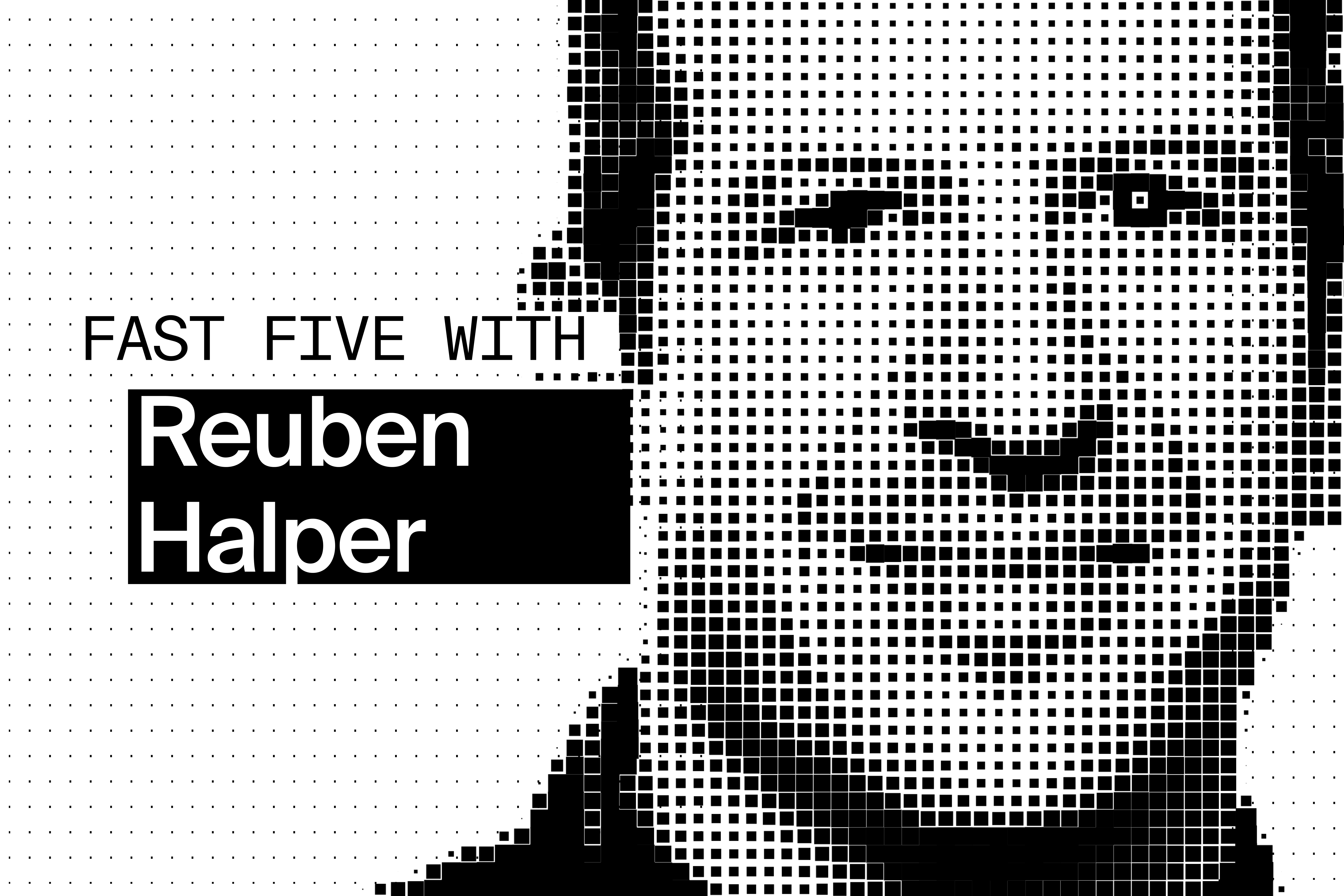
Fast Five with Reuben Halper
Fast Five is our rapid-fire interview series, 5 questions, 5 minutes. Next up, Reuben Halper shares sharp insights on creativity, advertising, AI and more.
Insights
Name
Reuben Halper, Head of YouTube, Google New Zealand
How do you define creativity?
I'm a bit of a cynic in this space and think the idea of creativity as something truly original is actually overrated, given "humans abhor the new" . With that in mind my definition of creativity tends to be around combinatorial creativity where you combine existing ideas, insights, tech, etc. to develop something novel yet familiar. Or to quote Kirby Ferguson "Everything Is A Remix"
Is AI a friend or a foe?
Neither, it's a tool. In the same hands a hammer can be both a tool and a weapon. I feel the same way about AI.
Name a piece of work that AI could never have come up with?
I bet half the respondents will say Cadbury Gorilla and frankly I want to punch them in the face. I honestly don't think there's any idea that an AI could never have come up with as the space is evolving so rapidly and so much of the output comes down to the input and the prompting. I also want to include a non-advertising piece of creativity that an AI expressed in the form of the move that AlphaGo made in the second game vs Lee Sedol.
What’s the weirdest place you’ve ever found a great idea?
A bar in deep Alabama where a hardcore NASCAR fan asked why we couldn't visualise the effects of drafting. That became a massive project involving wind tunnels and patents.
Favourite AI hack or use case? What do you think it is good for?
NotebookLM is the shit for so many things both personal and professional. Probably my favourite general use case for GenAI is using it as a sparring partner and adversary to challenge my thinking.

Insights
Fast Five with James Hurman
Fast Five is our rapid-fire interview series, 5 questions, 5 minutes. Next up, James Hurman shares sharp insights on creativity, advertising, AI and more.
Insights
Name
James Hurman, Founding Partner, Previously Unavailable
How do you define creativity?
Original, engaging ideas, beautifully crafted.
Is AI a friend or a foe?
A friend in the right hands (good strategy people using it as a springboard, good creative people with great taste using it as a production tool) and a foe in the wrong hands (poor strategy or creative people, or anyone in marketing, using it to conceive and produce average work).
Name a piece of work that AI could never have come up with?
Basically any big Lion-winner. But I'm going to pick on Heinz' 'Ketchup Fraud' as I don't think an LLM would ever be in a position to notice a restaurateur pouring cheap ketchup into a Heinz bottle.
What’s the weirdest place you’ve ever found a great idea?
Around the back of a service station in Pakuranga. It was under a random big sheet of cardboard that someone had spilled quite a lot of JD's and coke on. It was quite cold and the idea looked sad and quite sketchy but I could tell it was a great one. I was nervous about just taking it because there was a security camera there, but I had a hoodie on so I pulled up my hood and put my sunglasses on and turned away from the camera and grabbed it. Then a woman came busting out the back door of the service station and saw me and shouted something about me smelling like JDs, not realising that it was the cardboard and not me. I was going through a period of using quite a lot of Lynx Africa so I was pretty confident I didn't smell of JDs and instead I would most likely have been giving off an aromatic, woody, powdery oriental accord opening with notes of lime, mandarin, lavender, apple and galbanum which lead to a heart of geranium, rose, Jasmin and lily on a base of cedarwood, sandalwood, amber, musks, patchouli, Tonka, vanilla and moss. Anyway, the woman was pretty grunty and came at me hard. I was shitting myself so I dropped the idea and ran really fast down the road and then hid behind one of those old telephone exchange boxes for a while until it was safe to come out. Then I walked home and watched an old episode of M*A*S*H to calm down.
Favourite AI hack or use case? What do you think it is good for?
Talking to ChatGPT in audio mode to understand things that I'm thinking about or working on. It's great for constant fact checking or deepening my understanding really quickly without needing to switch tabs or context switch.
Insights
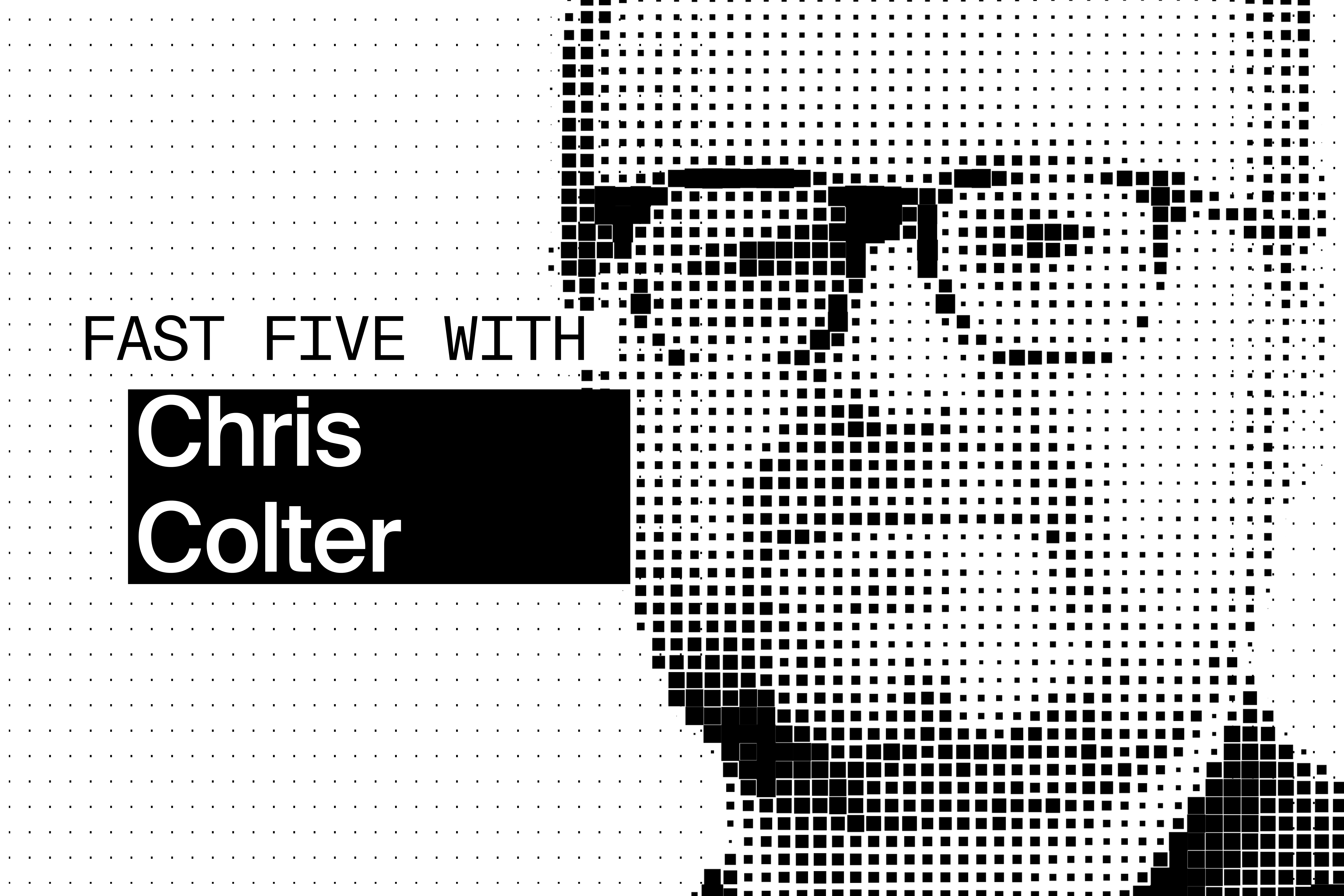
Fast Five with Chris Colter
Fast Five is our rapid-fire interview series, 5 questions, 5 minutes. Next up, Chris Colter shares sharp insights on creativity, advertising, AI and more.
Insights
Name
Colts (Chris Colter), Managing Director, Media Strategy, Accenture Song A/NZ Australia
How do you define creativity?
Originality
Is AI a friend or a foe?
Copilot
Name a piece of work that AI could never have come up with?
I honestly don’t think there is an idea AI could never arrive at without the right prompts from a human working in tandem.
What’s the weirdest place you’ve ever found a great idea?
In a nightmare.
Favourite AI hack or use case? What do you think it is good for?
Deep research to help me answer a Springboards “fast five” survey without sounding like a novice.
Insights
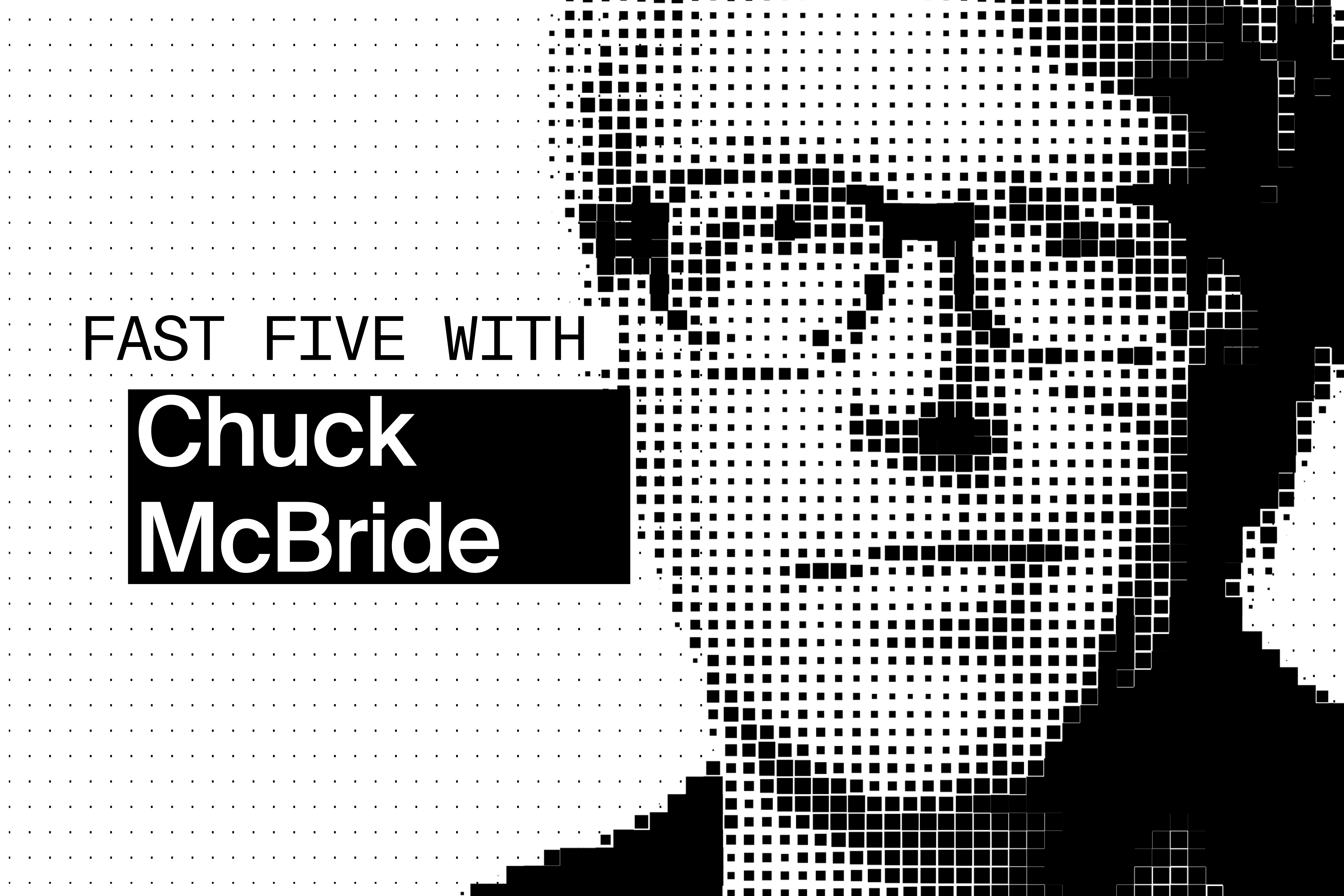
Fast Five with Chuck McBride
Fast Five is our rapid-fire interview series, 5 questions, 5 minutes. Next up, Chuck McBride shares sharp insights on creativity, advertising, AI and more.
Insights
Who are you?
Chuck McBride, CCO & Founder, Cutwater Agency
How do you define creativity?
It’s the act, the will, and the want to make something absolutely wonderful for everybody to enjoy. It’s about showing that you really care about the process, the work, and the people you’re giving it to. And wanting to make a difference in people’s lives.
Is AI a friend or a foe?
AI is a friend, at the beginning.
Name a piece of work that AI could never have come up with?
Any John Coltrane song.
What’s the weirdest place you’ve ever found a great idea?
In an argument.
Favourite AI hack or use case? What do you think it is good for?
Right now it is better to search with AI and not google. Simple way to up your game.
Insights
When Humans + AI Work Together to Create Adorable Mood-Boosting Gummies
In just 24 hours at SXSW London, Jellyfish used Springboards, Pencil and Veo3 to create Moodlings, a gummy brand. A masterclass in human + AI creativity.
Insights
Our friends over at Jellyfish built a brand from the ground up in only 24 hours. This was the challenge they took on during SXSW London in June as part of British Interactive Media Association (BIMA) House. With a combination of AI tools, they built a brief, worked on the strategy, came up with concepts and created a full campaign for the new brand in less than a day.
Jellyfish strategists used Springboards and Pencil to come up with the name, proposition and core concept for the fictional brand. Then the creative team picked up the baton, using Pencil and Veo3 to spin up the visuals, OOH campaigns, and a super fun 30 second ad.
What resulted was Moodlings, “a premium, mood boosting gummy brand”, and you’ve gotta admit - it’s adorable. We got the warm fuzzies when we first saw the brand. The team developed four different brand avatars, each with its own unique taste and fun packaging.
The human team included: Tom Roach, Emily Collins, Lucas Stanley, Gemma Cotterell, Sam Yates, Margaux Dalgleish and Sahar Amer, who worked together to build everything from brand strategy to execution using a combination of AI-powered creative tools.
Not only were the Moodlings cute, the ad also performed well when tested in potential real world scenarios. Jellyfish ran it through their own Share of Model™ platform, System1, and DAIVID, resulting in high scores across the board.
Moodlings is a masterclass in AI-powered creativity. It’s the perfect example of how AI allowed a team of strategists and creatives to get weird and push them to places they wouldn’t have been able to get alone in such a short period of time.
Let’s do more of this together.
Check out Tom Roach's post on Jellyfish here and Pencil's case study on the Moodlings that was featured in Google Cloud's latest blog.

Events
Brand Creative in the Age of AI Conversation with Peregian Digital Hub
Discover how Springboards’ founders turned AI experimentation into a platform that’s transforming agency creativity. Insights from the Peregian Digital Hub.
Events
Springboards co-founders Pip and Amy had a chance to sit down with Peregian Digital Hub Director, Chris Boden, to talk about how they went from freshly laid-off tech workers with a toddler to founders of an AI startup, changing the game for advertising agencies. Peregian Digital Hub is a self-proclaimed “gathering place for AI nerds” in Noosa, Australia, where the co-founders reside, and was a huge influence on kickstarting Springboards.
The conversation ranged from playing and tinkering with AI tools during covid times to building an MVP and learning what VC was, to today with over 100 agencies onboarded and using Springboards to supercharge their creative process. Read on for highlights from the conversation between Chris, Pip, and Amy.
What Business Need Does Springboards Solve?
If you haven’t heard, the ad industry’s got a problem. Margins are shrinking, and a big part of it is what we lovingly call the "pitching problem." Agencies are hustling harder than ever, sinking time and money into speculative work—creating entire campaigns for free just to win a client. It’s exhausting, expensive, and honestly, kinda soul-crushing.
That was the impetus for Springboards, the platform that puts creativity back in the driver’s seat without losing the human spark. Built by ad-world veterans, Springboards is an idea accelerator designed to speed up the creative process without watering down the magic. Think of it as your new brainstorming buddy, helping with everything from strategy to killer concepts.
Here’s what makes us tick:
- We Want to Fit Into Agency Workflows: Clients don’t just hire you for the work; they want ideas, innovation, and yep, even "someone to blame” if something goes wrong (no judgment!) Springboards isn’t supposed to replace your process—it powers it, giving you more firepower to deliver fresh, unexpected ideas.
- Not Designed to Give You Answers but an Inspiration Overload: Springboards isn’t about spitting out the answer. It’s about throwing a hundred weird, wild, and wonderful ideas your way so you can pick the best and make them better. It’s like a workshop in your pocket, minus the bad coffee and awkward icebreakers.
- Humans Always Come First: This isn’t some “robots-take-your-job” story. Pip and Amy built Springboards to keep people in the creative equation. The platform is there to amplify your genius, not replace it. We like to think of it as the Terminator story - we’re using humans partnered up with AI to fight the evil AI.
- Say Goodbye to Meh Ideas: AI often has this nasty habit of playing it safe and turning out stuff that’s painfully average. We hate that. So we’re constantly tweaking Springboards to make sure it doesn’t fall into that trap. The goal? Help you hit the jackpot without settling for "fine."
Springboards isn’t just helping agencies work smarter—it’s flipping the script for teams and entire agencies:
- One user told us, “With Springboards, I feel like I can take on any agency out there.” That’s the energy we live for.
- Pitches are turning into wins: Agencies using Springboards have more wins under their belts. One client even joked, “The only problem is, I don’t have enough briefs to answer anymore.”
What’s Next?
We’re not stopping here. With plans to continue growing globally and a laser focus on fighting creative entropy (aka the soul-sucking sameness that kills good ideas), Springboards is on a mission to keep creativity alive and well.
Our promise? To keep pushing boundaries and helping the world’s creatives do what they do best: make weird, wild, wonderful things happen. Check out the full interview here for more insights.
Ready to rethink how you work? Join the Springboards revolution, and let’s keep creativity where it belongs—in human hands. Request a demo today at https://springboards.ai/#demo.

Insights
How one post from Zoe Scaman lit up the creative world about Springboards
What started as a single post from strategist Zoe Scaman became a rallying cry for better creative strategy. Explore how it led to the unplanned launch of Springboards.
Insights
When creative industry visionary Zoe Scaman drops a post about a game-changing new tool, the creative world perks up. Known for her unfiltered insights and knack for spotting what’s next, Zoe’s Tweet and LinkedIn post about our product—Springboards—was nothing short of electric.
Here’s how she thrust Springboards into the spotlight:

Credit: https://x.com/zoescaman/status/1725089109436199152
The Cat Was Out of the Bag
Replies started stacking up almost immediately. Agency folks and strategists jumped into the conversation, buzzing with questions and speculation and it was clear that Springboards could no longer operate in the shadows of beta testing agencies.
After taking a second to shake himself and realize he wasn’t dreaming, our co-founder Pip Bingemann chimed in to share his excitement.

So What is Springboards, Anyway?
Springboards is a suite of AI tools that loosely mirrors a traditional creative process. Spoiler alert: we won’t give you the answer, but we’ll give you sparks to help you get there. Little thought starters to get your head thinking and give you the ability to EXPLORE more ideas than you ever could before. It’s the act of exploring and playing that leads to great creativity and we are built to do just that. We want to accelerate human creativity and help you have some fun along the way.
What Makes Us Different
Springboards isn’t built like your typical LLM that just wants to pump out answers; we’re built for creative sparks. We’ve reprogrammed them to keep giving you fresh answers, instead of the same cookie-cutter answers that you see after you keep prompting with your standard LLM. We’re not here to give you the answer and we want you to jump into the sandbox with us and get messy and come up with ideas together. We want this process to be fun for you and we’re hoping to help spark those ideas to get you places you wouldn’t alone.
How Did We Get Here
We started experimenting with AI because we thought the technology was good, but the product (ChatGPT and others) were shit. It was too generic and took too much hand holding to get anything decent. We built something for ourselves to bring the thrill back to the creative process. We were tired of the same-old, same-old, using tools that promised creativity but delivered dull, predictable content. So, we set out to build something different. Something that makes creative work feel as inspired as it should. Springboards isn’t your average AI tool. It’s a creative tool to help you spark creativity, NOT give you the answers. It’s designed specifically to give agency creatives superpowers, built by agency people who truly understand the needs of this industry.
The early response from our beta was beyond what we’d hoped. When creatives like Zoe started sharing their excitement, we knew we’d struck a chord. People are seeing that Springboards isn’t just another tool—it’s a partner, designed to challenge you, expand your ideas, and bring real, unexpected fun back into the mix.
A Glimpse at What’s Next
Zoe’s post was only the beginning. In minutes, it sparked a wave of curiosity, and soon our inbox was overflowing with demo requests. So yeah, we had to create a waitlist, thrilled that so many people want to be part of this journey with us. But we’re just getting warmed up.
The waitlist wasn’t just a buzz-builder. With Springboards, we’re bringing a fresh approach to how agency creatives work, so we want to make sure each demo is personal, interactive, and tailored to show what Springboards can really do. Yes, it means we are a bit slower to get through everyone, BUT it also means people understand not just WHAT Springboards can do, but WHY it was created and HOW to get the most out of it.
We’re planning an official launch to share with everyone what we’ve been working on and we’re gearing up to make an even bigger impact. We’re bringing more features, more fun, and even more ways for you to push creative boundaries.
If this has you curious and you want to break out of the boring, request a demo today and get ready for what’s next.
.svg)